
Lighting guide
Approved LED lighting products: what to check in Ontario
A familiar logo or an attractive online listing does not settle whether a light is approved for use in Ontario.

On this page
Start with recognized approval of the complete lighting product, then check whether that product suits the intended installation. These are related but separate questions. A fitting may have recognized electrical approval and still be inappropriate for a shower, a particular insulated ceiling or a proposed dimmer. A weather rating or a thin profile cannot answer the approval question by itself.
For a Burlington lighting project, collect the exact model, product documents and intended location before committing to an order. Online photographs and broad descriptions are useful for appearance, but the assessment needs the actual product. This is especially important when a product family contains different drivers, outputs, trims or exposure ratings.
Use ESA’s recognized marks as the starting point
ESA explains that applicable electrical products in Ontario must be approved by an accredited certification or evaluation agency and carry its official mark or label. Use ESA’s recognized approval marks page to check the actual mark. Recognition can depend on the mark’s form and scope, so a familiar agency name alone is insufficient.
The same ESA page separates component recognition from markings recognized on complete end-use products. A recognized component can be intended for incorporation into a larger approved system; its marking does not establish approval of an assembled light. A driver’s component mark should therefore not be treated as the complete fixture’s approval evidence.
Ask the seller for product-specific evidence that relates to the exact item you would receive. If the information is unclear, have the responsible Licensed Electrical Contractor or ESA clarify it before purchase or installation. Do not rely on a marketplace statement that products are certified somewhere, or on a mark that appears only in a generic promotional image.
Distinguish appearance claims from approval evidence
An online listing may emphasize a modern finish, selectable colour or a compact body. Those features can be relevant to the design, but they do not identify the approval position. Keep the product’s commercial description separate from the documentation used to assess it. A photograph of an installed light cannot resolve a missing product identity.
Terms such as energy efficient, weather resistant or professional quality describe other claimed qualities. They should not replace recognized complete-product approval. Likewise, do not treat a CE label, IP rating or efficiency label as interchangeable evidence of Ontario approval. Establish the electrical approval question through the appropriate recognized Canadian marking.
For new pot light installation, ask which exact models are proposed and whether their associated components belong to the specified assembly. If supplying fixtures yourself, share the documents early. A review before ordering is more useful than discovering an unresolved approval question after a ceiling layout has been designed around the product.

Check the location separately
A dry living-room ceiling and a light above a shower have different exposure conditions. ESA’s bathroom guidance calls for shower lighting marked suitable for wet locations on the product and packaging, and emphasizes the manufacturer’s installation requirements. Approval alone does not make a fixture suitable for that use.
Describe the actual location rather than asking whether a product is “good for bathrooms.” A ceiling outside the shower and a fitting within the shower area are not the same application. The room name is a starting point; the position, exposure and instructions are the details that need review.
Bathroom lighting assessment can consider those differences alongside useful light at the mirror and throughout the room. Keep each layer’s purpose clear. A suitable recessed fitting above a wet area does not necessarily provide the best face lighting at a vanity, and a decorative vanity fitting does not establish suitability above a shower.
Exterior suitability includes more than a rain claim
A sheltered soffit, open wall position and exposed landscape location can present different conditions. Give the assessor a photograph showing the actual shelter and mounting position. Describe whether the space is enclosed, open or exposed rather than choosing a product solely because an online title uses the word outdoor.
Read the manufacturer’s documented location and operating conditions for the selected model. An exterior application may involve moisture, temperature and mounting questions that differ from the living-room version of a visually similar product. Do not assume an indoor fitting becomes suitable because its opening is covered by a roof overhang.
For exterior and soffit pot lights, identify the intended roofline, entry or wall area and any existing equipment being retained. The product specification should follow that location. A single weather number should not be used as the whole test of electrical approval and installation suitability.

Insulation suitability is another independent check
A ceiling cavity can contain insulation even when it is not readily accessible. Ask how the complete fixture and any associated enclosure are permitted to sit within the actual assembly. The manufacturer’s instructions should guide the assessment. A light’s small size, low wattage or LED source is not evidence that any arrangement beside insulation is acceptable.
Natural Resources Canada’s roof and attic guidance discusses recessed fixtures, insulation and air sealing. Where the ceiling forms part of the building envelope, those details deserve explicit attention. Fixture selection should account for the assembly instead of treating the visible opening as the only ceiling condition.
A manufacturer’s specification can list Canadian certification, wet-location suitability and insulation-contact suitability separately. These independent entries are useful evidence that the questions should be checked separately. An affirmative answer to one does not imply an affirmative answer to the others; the final installation must suit all relevant conditions.
Approval does not guarantee dimmer compatibility
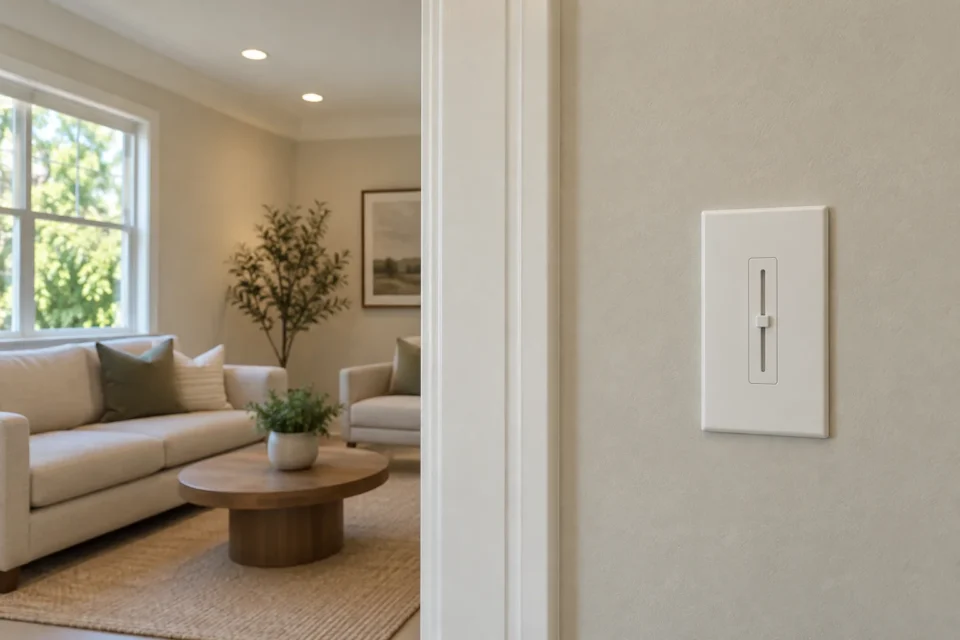
A selected LED fixture, driver and control must work as a compatible combination for the intended use. The fixture being approved does not mean it can be connected to any dimmer, and a product described as dimmable still requires an appropriate control. Ask for the manufacturer’s applicable compatibility information for the exact models.
Decide how the room will be operated. A light that must support gentle evening use has a different practical brief from one normally used at full output. Ask about the supported dimming approach and intended range before purchase. Avoid treating the compatibility of another product in the same catalogue as proof for the chosen fixture.
Retained controls also belong in the assessment. Provide saved model information where available and describe whether the control is staying or changing. You do not need to open the wall device to start the inquiry. If its identity cannot be established from ordinary information, let the responsible contractor assess it.
Review the complete assembly and installation instructions
Some systems contain a light body, driver, connection enclosure, mounting parts and optional accessories. Ask which parts are included and which are required for the proposed installation. The approval evidence and instructions need to relate to that complete arrangement. Combining parts from unrelated listings can raise questions that a matching visible trim does not resolve.
Product substitutions deserve review too. A different driver, retrofit module or accessory may affect compatibility and the specified installation. If availability changes after the quote, ask for the replacement model and revised documents before accepting it. Similar appearance and the same nominal diameter do not make two assemblies equivalent.
Keep the instructions accessible to the contractor and retain a copy for future reference. They identify the selected product’s permitted use and service approach more accurately than a remembered seller description. Avoid modifications intended to make an unsuitable product fit a ceiling or operate with a control.
Keep a useful product record
For each selected fixture, record the manufacturer, model, relevant options and final setting where applicable. Keep the purchase information, product sheet and installation documents together. If different rooms use similar-looking variants, identify which one belongs to each location so later maintenance does not depend on guessing from the trim.
A missing record does not automatically prove an existing light is unapproved. It means the identity or evidence needs assessment before a confident selection or replacement decision can be made. Do not remove installed electrical equipment to collect information for an initial inquiry. Start with visible views and saved documents.
If approval evidence remains unclear for a prospective purchase, resolve it before installation. If there is concern about existing equipment, arrange professional assessment rather than assuming normal operation demonstrates compliance. Clear documentation makes the decision reviewable without turning the homeowner into a product-certification specialist.
Use five questions before ordering
- Is the complete product appropriately approved for Ontario?
- Does the exact model suit the intended exposure and operating conditions?
- Does it suit the ceiling assembly, including relevant insulation conditions?
- Can the full assembly be installed and serviced as instructed?
- Is the fixture and driver combination compatible with the intended control?
Keep each answer tied to the named product and actual location. The lighting guides explain related planning decisions. To request an estimate, share the room or exterior view, the intended change and any fixture documents already available. A clear product and application brief is the best starting point for resolving these separate checks.
Frequently asked questions
Does a recognized component mark approve the whole light?
No. Component recognition and complete end-use product approval are distinct. Check the complete product and exact recognized marking.
Does approved mean suitable above a shower?
No. Wet-location suitability and the manufacturer’s installation requirements need their own review for the actual position.
Is an IP rating the same as Ontario electrical approval?
No. An IP rating describes an enclosure-related characteristic; recognized complete-product approval is a separate question.
Can every approved LED work with a dimmer?
No. The selected fixture, driver and control require compatible specifications for the intended operation.
What information helps review an owner-supplied fixture?
Provide the exact model, product sheet, installation instructions, approval information and intended location through the project inquiry.