
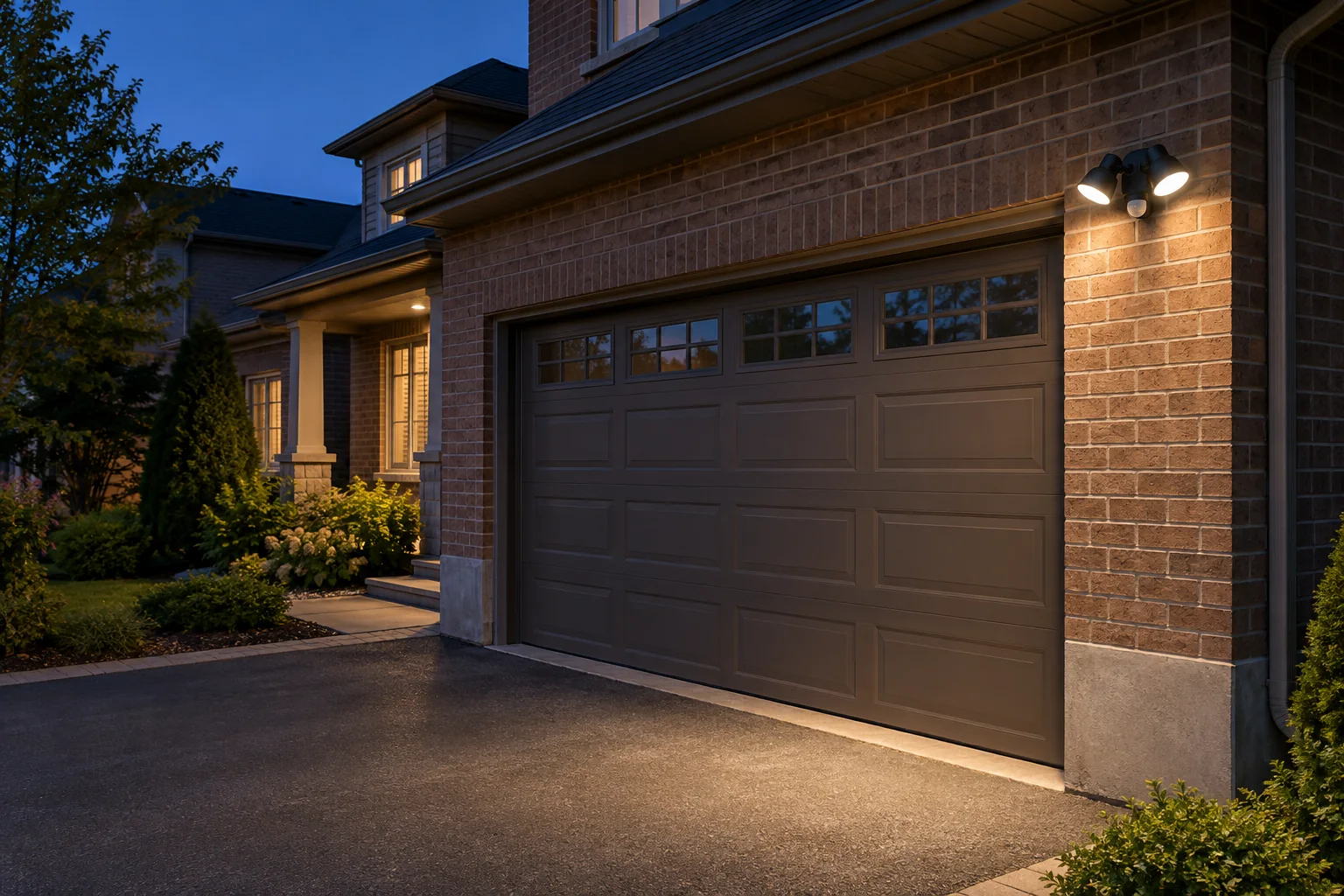
Light that responds at a defined approach
Motion lighting brings light to a residential entrance, driveway or side-yard route when movement is detected. A useful Burlington installation begins with the approach you want covered and the part of it that needs illumination. The sensor’s detection area and the fixture’s light distribution are related, but they are not the same thing: a light can respond to movement while still leaving the doorstep in shadow.
This service covers motion-triggered exterior lighting and its practical coverage, operating controls and nuisance activation questions. The word security describes the common fixture category; lighting does not guarantee crime prevention, personal safety or a security outcome. The intended result is useful visibility at an agreed residential access point.
For continuously lit paths or garden areas, compare Outdoor & Landscape Lighting. Recessed roofline lighting belongs to Exterior & Soffit Pot Lights. A property may benefit from more than one layer, with each assigned a clear purpose rather than turning every fitting on whenever one sensor responds.
Define the route before choosing the fixture
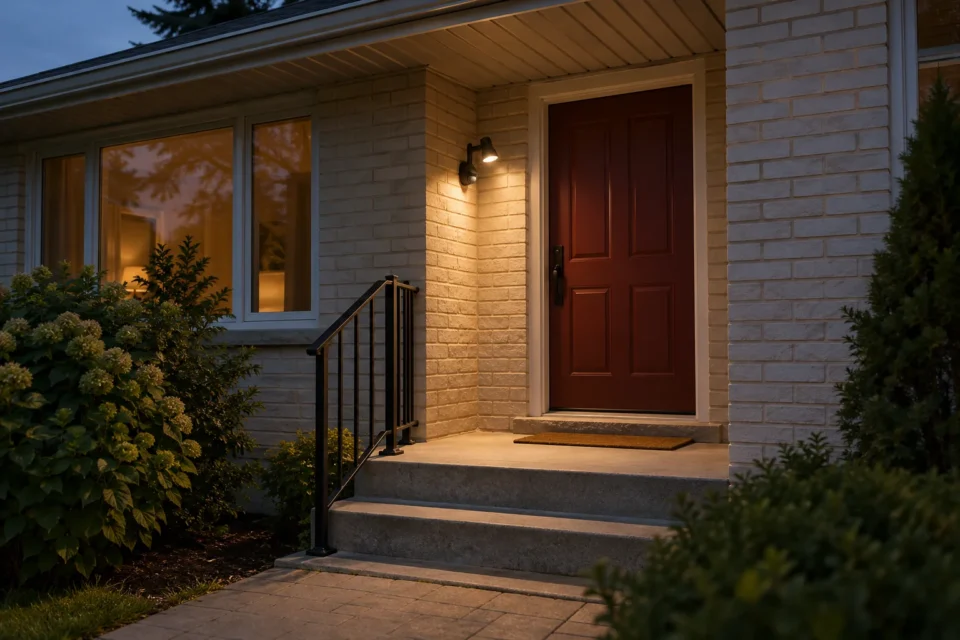
Think through an ordinary arrival. Where does a person enter the property, where are the steps or turns, and when should the light become useful? A front door, side gate and garage approach may need different positions. A fixture installed wherever existing wiring happens to be available may not cover the intended route effectively.
Parked vehicles, porch columns and garden structures can block either light or the sensor’s view. Include those conditions in the discussion, including the normal position of bins and seasonal furniture. A driveway that is empty during an assessment may behave differently when a vehicle is beside the entrance.
The mounting surface and available electrical point also need assessment. The selected unit must support the actual location and orientation specified by its manufacturer. Do not assume a wall-mounted sensor fitting can be moved into an overhead position without changing the choice or installation arrangement.
Send safe daytime photographs from the approach and from the proposed mounting area. Explain the usual direction of travel and any dark threshold or step. You do not need to walk in an unsafe area after dark to demonstrate the issue; a sketch and description can establish the starting requirements.
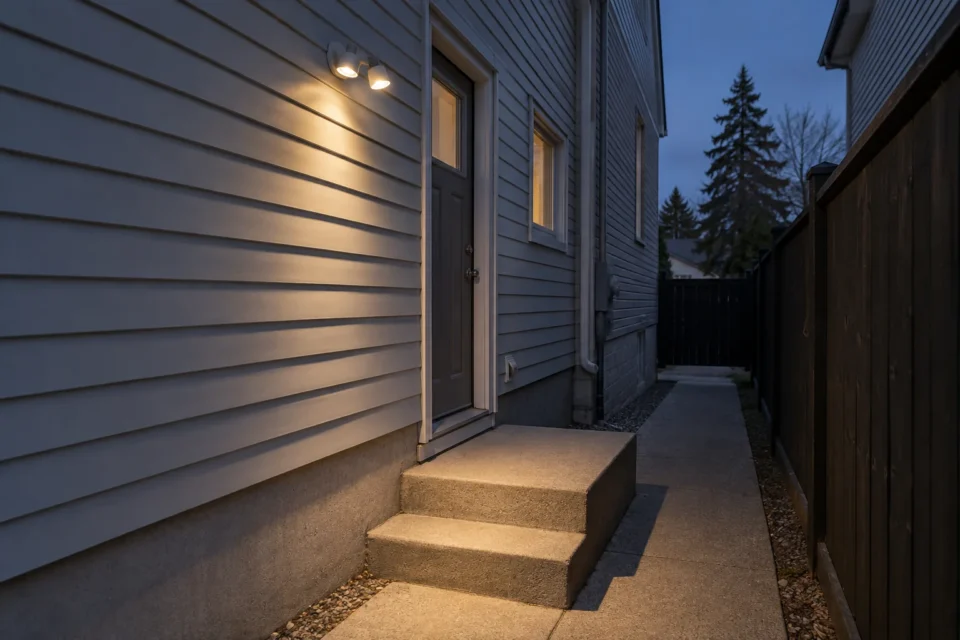
Choose detection and operating options together
Motion-light products offer different sensor and control capabilities. Depending on the selected model, settings may include sensitivity, operating duration, daylight control or brightness. These options should be confirmed from the actual product rather than assumed from a photograph or a broad description such as smart security light.
A longer stated detection distance is not automatically better for a small entrance. The useful detection area should relate to the property and the route, with unwanted areas considered as well. A wide setting may respond beyond the place you intended, while an obstructed position may miss part of the normal approach.
Discuss how long the light should remain on and whether a manual operating mode is needed. Someone unloading a vehicle or working briefly at a door may want a different setting from a person simply passing through. Confirm how the chosen fitting returns to automatic operation and how the wall switch should be used.
If the proposal includes an app or a broader control system, consider ordinary manual use too. The Smart Lighting & Dimmers service covers connected control changes. A motion fixture should remain understandable to the people using the property, with its operating arrangement included in the agreed scope.
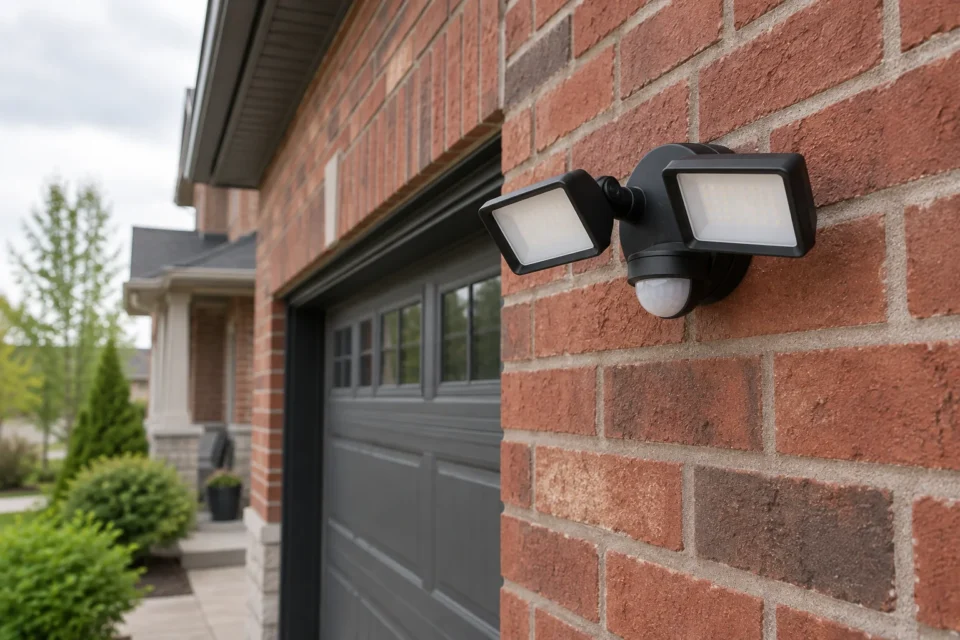
Reduce unwanted activation and light spill
Identify where activation would be unwelcome: passing movement outside the property, a neighbour’s access route or parts of the garden that are not relevant to the task. Explain when the current light comes on unexpectedly and what is normally happening nearby. Observations are more useful than guessing that every nuisance activation means the sensor is defective.
Placement, sensor settings and the selected equipment need to work together. Surrounding planting, obstructions and the intended detection direction should be reviewed against the manufacturer’s instructions. The aim is a practical operating pattern; no installation should promise that unwanted activation can be eliminated under every outdoor condition.
Light spill is a separate question from triggering. Even a correctly triggered fixture can create glare at a neighbouring window if its head or output is unsuitable. Direct the useful light to the landing, paving or approach instead of assuming the widest possible flood is necessary. Review the source from nearby ordinary sightlines, including people standing at the gate.
The outdoor lighting and neighbour considerations guide explains the planning context. The City of Burlington’s Guidelines for Outdoor Lighting, revised 28 October 2008, address residential glare and spill, with requirements depending on the property and scope. Product settings should support a suitable fixture position, rather than being used to compensate for an inappropriate one.
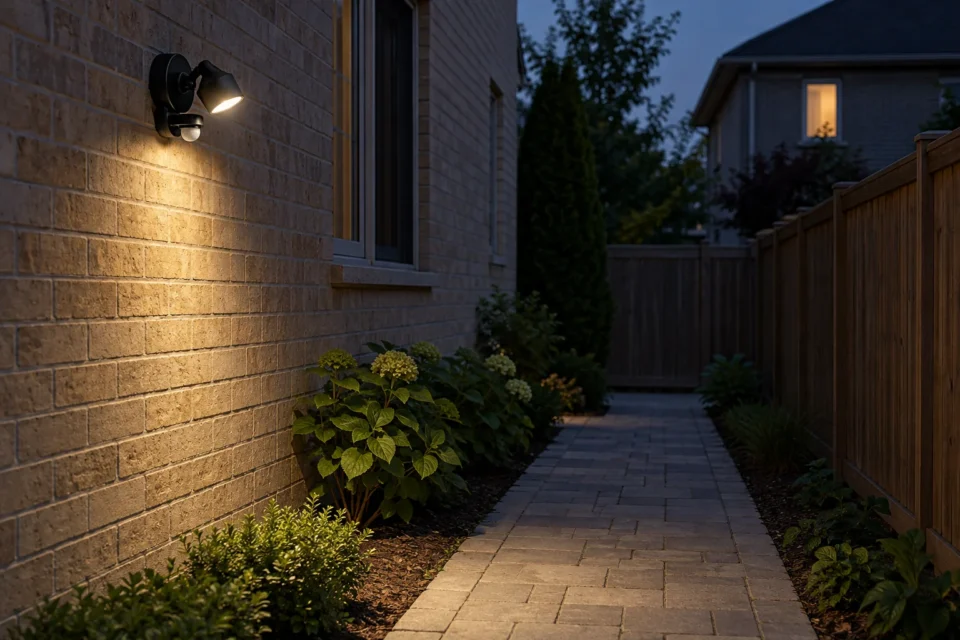
Balance useful coverage with comfortable arrival
The doorway, lock, landing and step edges are useful assessment points. Brightness at the centre of a driveway does not show whether a visitor can see the threshold comfortably. Two adjustable heads can sometimes serve different surfaces, but the selected fitting and its mounting height determine what arrangement is practical.
Consider the transition between the unlit route and the lit landing. A very bright source in the line of sight can be distracting even when the paving receives plenty of light. Shielding, head orientation and output need to be reviewed together. A quieter, well-directed arrangement can be more useful than a high-output fixture aimed across the whole frontage.
Existing decorative or path lights may already cover part of the arrival route. Include them in the plan so the motion layer addresses the remaining need. Where the property has more than one entrance, decide whether separate detection zones make more sense than one unit attempting to cover distant approaches.
Rental and condominium properties may have permissions or shared-element limits affecting exterior equipment. Resolve who owns the mounting surface and electrical supply before a fitting is specified. These responsibilities should be clarified alongside the lighting task, rather than left until installation is arranged.
Assess product suitability and electrical supply
The fixture must be suitable for its actual exposure and installed orientation, with recognized Canadian electrical approval as applicable. A weather rating alone does not establish every product and installation requirement. The housing, sensor, power arrangement and manufacturer instructions should be considered together.
Replacing an existing fitting and adding a new electrical point are different scopes. The assessment should establish the condition of the existing equipment, available supply, proposed mounting and control arrangement. If the current light fails, cycles or remains on unexpectedly, describe the symptom before assuming a new sensor unit is the whole answer.
Lighting Repairs is relevant when unreliable operation is the main concern. For a separate failure involving recessed eave lights, soffit-light failure guidance helps organize those observations. Do not open a fixture, climb to its wiring or repeatedly manipulate damaged equipment to prepare an inquiry. Safe photographs and a description of observed behaviour are enough.
When hiring electrical work in Ontario, verify the Licensed Electrical Contractor through ESA. New wiring and most electrical installation work require an ESA Notification of Work, with specific exceptions for some replacements. Confirm the actual requirements with the contractor or ESA. A motion sensor does not make the associated electrical installation exempt.
Prepare a motion-lighting request
The quotation depends on whether supply is already available, the condition of the electrical point, mounting access, fixture selection and the number of approaches involved. Surface openings, routing and making good can also affect the work. Ask for the intended locations, control functions and included adjustments to be described clearly.
Prepare the motion-lighting assessment around:
- Property, approach and fixtures: Share the property location, the route you want lit, safe daytime photos and any existing fixture details.
- Detection and operating conditions: Explain nuisance activation, desired operating times, nearby windows and common obstructions.
The Lighting Services directory helps distinguish related exterior work; use the contact form to request assessment of the complete situation.
Confirm the intended operating result
Before positions are finalized, describe several normal situations: returning from the driveway, opening the side gate and spending longer at the entrance. Explain which should trigger the light and which nearby movement should be outside its intended task. This helps establish an operating plan that can be discussed clearly instead of relying on a headline detection range.
Ask how the agreed coverage and product-specific settings will be reviewed as part of completion. The result should be considered from the normal approach and at the nearby sightlines that matter. Any adjustment should follow the selected manufacturer’s instructions and remain within the professional installation scope; there is no need to climb to a fitting or open equipment yourself.
Keep a record of the chosen operating mode and how the ordinary wall switch affects it. If behaviour later changes, describe what you observed and whether the control settings or surrounding layout changed. Moving furniture, planting growth and a revised access route can alter the practical context even when the fitting itself remains in place.
Motion & Security Lighting Gallery
Motion & Security Lighting Questions
Does motion lighting guarantee security?
No. The service concerns useful visibility at a defined approach. Lighting does not guarantee crime prevention or a security outcome; other property-security decisions have their own scope.
Can one motion light cover every entrance?
Not necessarily. Detection and useful light distribution depend on the actual unit, position, route and obstructions. Separate approaches may need separate zones rather than one fitting set to its widest range.
Can nuisance activation be reduced?
Placement, detection direction and product-specific settings should be reviewed together. Describe the unwanted activation and nearby movement. No installation should promise elimination under every outdoor condition. See outdoor lighting considerations for boundary planning.
Can I adjust how long the light stays on?
Some models offer operating-duration and other control options. Confirm the actual product's functions and how manual operation works. Smart Lighting & Dimmers covers wider control upgrades.
What if an existing motion light is unreliable?
Describe whether it fails to activate, triggers unexpectedly or remains on. Lighting Repairs is relevant for assessment before a replacement solution is assumed.
What should I send for an assessment?
Share safe daytime photos, the intended approach, nearby windows, obstructions and existing equipment details. Use the contact form to explain when and where useful light is needed.