
Lighting guides · Burlington exterior light
Outdoor Light That Serves the Property and Respects Nearby Views
Plan Burlington exterior lighting around useful surfaces, comfortable views and the property boundary.
On this page
Start with the place that needs illumination
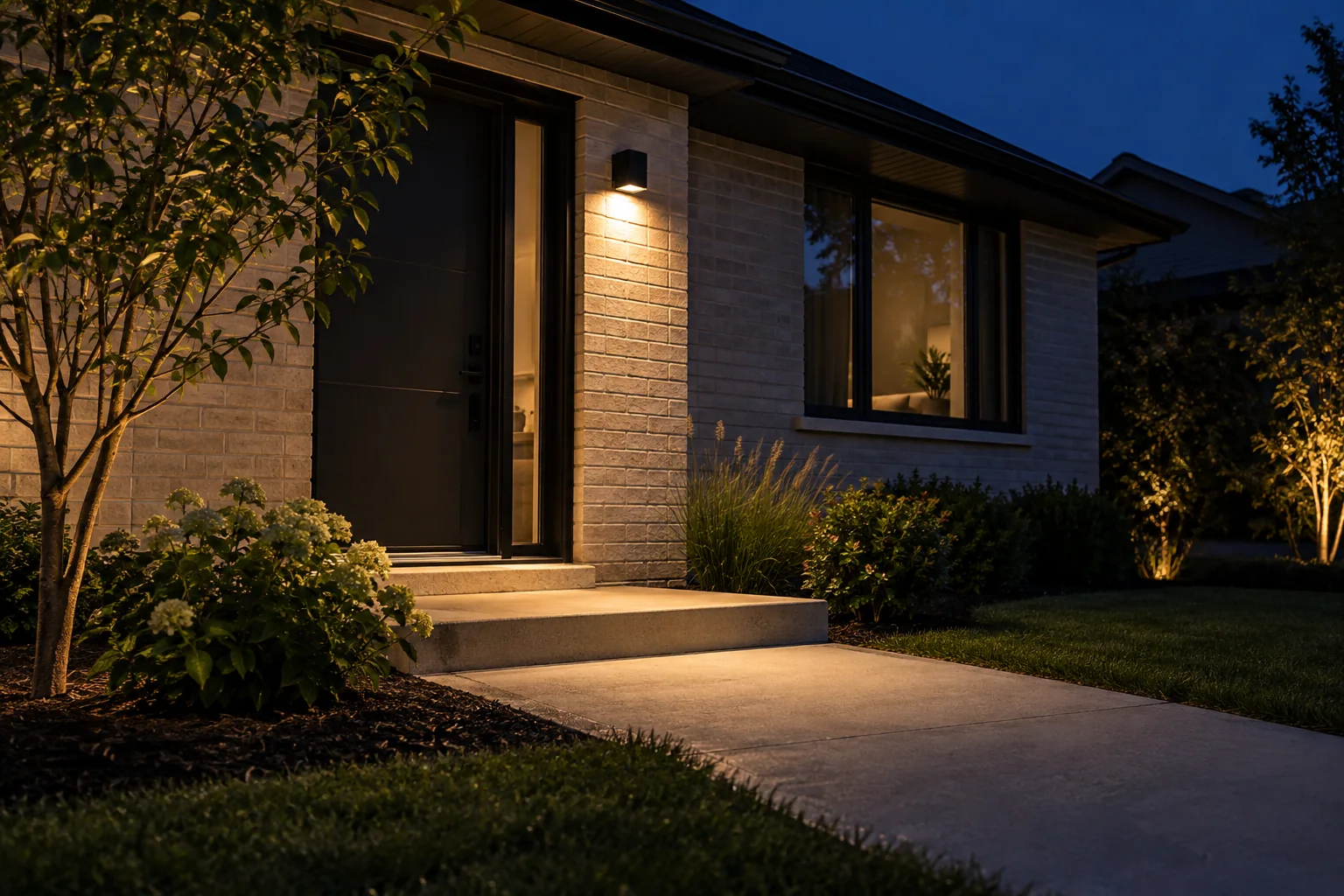
Good outdoor lighting brings useful light to a defined place while limiting unwanted brightness elsewhere. A front step, a side gate and a sitting area have different needs. Begin with the route or activity, then consider the fixture’s direction, shielding, output and operating times together. A brighter lamp does not automatically create a better outdoor view.
For Burlington residential properties, neighbouring windows, close side yards and views from the street make those decisions especially relevant. The actual relationship between buildings matters. A fitting may be comfortable from your patio yet visible as a bright source from a bedroom across the fence. Review the property in context instead of judging the fixture only from beneath it.
This guide explains glare, light trespass and the careful use of City guidance. Recessed roofline installation belongs to Exterior & Soffit Pot Lights. Path and garden applications belong to Outdoor & Landscape Lighting. Each can contribute to an exterior plan, provided its purpose and boundaries are clear.
Glare and light trespass describe different problems
Glare concerns brightness that makes viewing uncomfortable or interferes with seeing the scene. A visible light source can attract the eye more strongly than the surface it is intended to illuminate. Reflections can also matter: pale masonry, glass and wet paving can return light toward a viewpoint. The issue is the relationship between the source, surroundings and observer.
Light trespass concerns light reaching beyond the intended area, particularly across a property boundary or into a neighbouring space. It can occur even when the source itself is hidden. A downward-directed fixture may illuminate a bright surface that reflects light outward, or its distribution may extend farther than the entry landing it was meant to serve.
These concerns can overlap but should be recorded separately. Say whether a neighbour can see the bright source, whether their wall or window is illuminated, and when the condition occurs. That description is more useful than calling every outdoor concern too much light. A professional can then consider the fixture and arrangement without assuming a single cause.
What Burlington’s published guidance says
The City-hosted Guidelines for Outdoor Lighting is marked revised 28 October 2008. Its section 3.2.1 expressly includes residential yard lights and residential uses among the outdoor applications it addresses. Its general provisions discuss shielding, glare, sky glow and light trespass; the document also identifies stated exceptions.
Section 4 separately addresses new development applications and their submission evidence, including lighting and photometric documentation. That application-stage material should not be turned into a universal homeowner checklist for every soffit replacement or residential lighting change. The applicable review depends on the property, proposal and current requirements.
The City’s current urban-design page describes its guidelines as direction used in development review and City projects. When a proposed lighting change is part of a development application or a wider alteration, ask the City what information is required for that scope. For an ordinary residential assessment, use the published principles to frame questions and verify any applicable obligations rather than declaring the 2008 document a universal current residential bylaw.
No general colour-temperature limit, fixture count or approval status is established by this guide. Such a claim would require the relevant current source and its actual application. A homeowner’s photograph also cannot establish compliance with a measured boundary limit.
Shielding directs attention toward useful surfaces
A shielded fitting limits views of its light source and the directions in which it emits light. That can help keep attention on a doorstep, path or selected feature. The product’s distribution and its installed orientation both matter. A fixture described as decorative or dark-sky friendly still needs to be reviewed in its actual location.
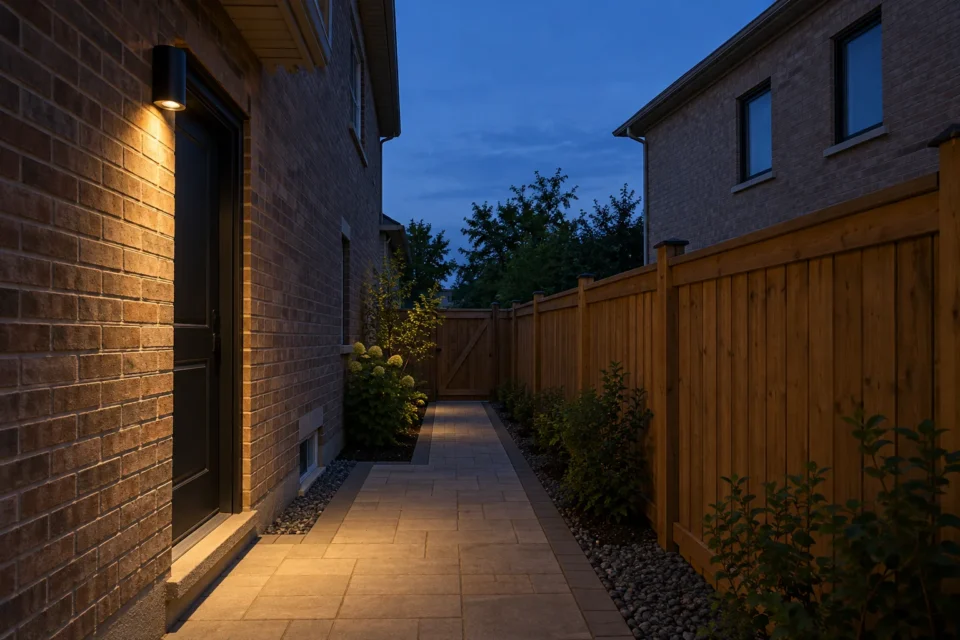
For a wall or soffit position, consider the observer below, along the approach and across the boundary. A deep porch may conceal a source from one direction, while an open side eave exposes it from another. A fence is useful context but is not proof that upstairs windows are screened. Include higher viewpoints wherever they are relevant to the proposal.
Choose a product and arrangement that serve the intended area without relying on improvised coverings. Altering a fitting, adding an unapproved shield or painting its lens can conflict with its instructions and change its behaviour. Discuss suitable optics and manufacturer-supported accessories with the person assessing the installation.
Restrain output before expanding coverage
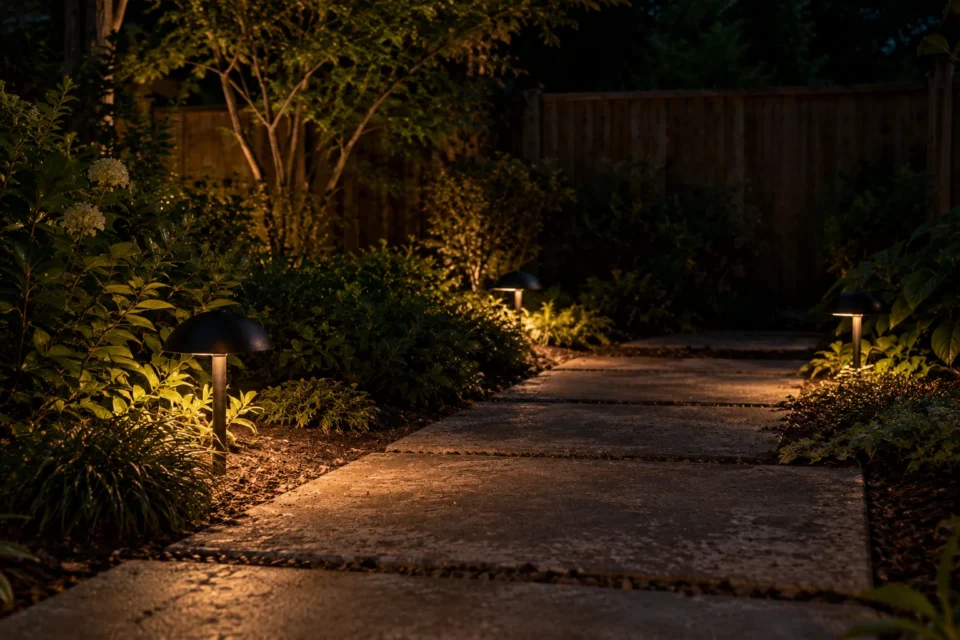
Identify the surfaces where visibility is needed and the contrast with the surroundings. A very bright doorway beside a dark route can draw attention to the doorway while leaving the next turn difficult to see. The answer may be a better distribution of restrained light along the route, not increasing one source until it reaches every corner.
Reflective surroundings affect the result. A light-coloured wall can become a large bright surface, while dark fencing absorbs more of the light reaching it. Wet pavement and glass produce different reflections from dry paving. Consider the ordinary seasonal conditions of the property without treating a single clear-night photograph as the whole picture.
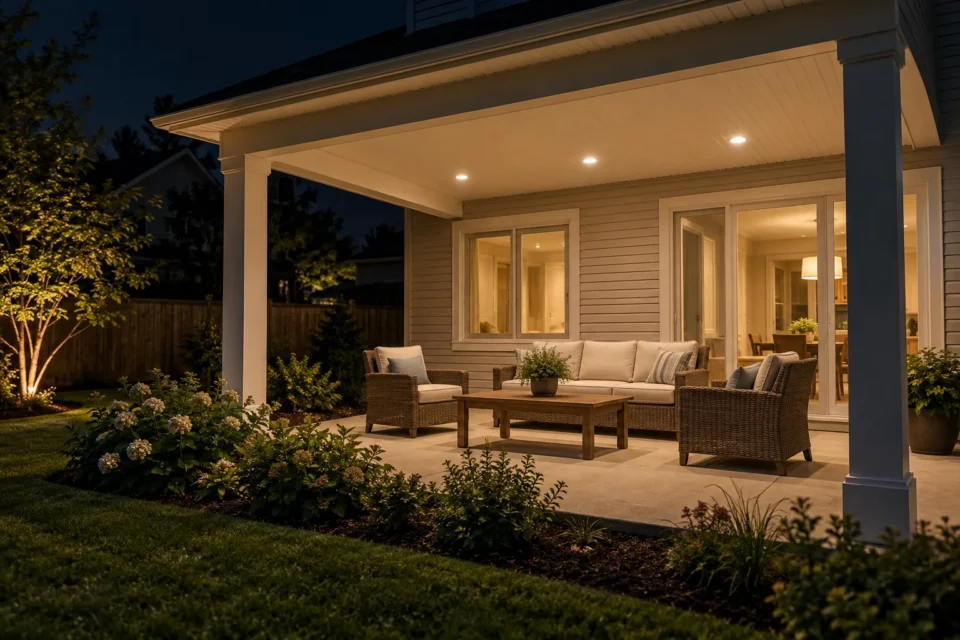
Separating practical light from architectural emphasis can also help. A façade need not be as bright as a working entrance. Give wall texture, a garden feature and an access route their own priorities, then omit positions that add little. More light around the entire perimeter can increase neighbouring exposure without improving the part of the property that people use.
Operating time is part of the design
A light that is appropriate during arrivals may become intrusive when it remains on after the activity ends. Discuss the time period that serves the purpose and the need for ordinary manual control. Scheduling, daylight response and motion activation can be useful options, but their suitability depends on the selected products and operating goals.
Motion lighting should address a defined approach. Detection can be affected by where the sensor faces and what movement occurs nearby. If it responds to a shared path or passing activity, repeated illumination can disturb neighbours even when the fitting’s beam is relatively restrained. Ask how the chosen arrangement will be reviewed for nuisance activation.
Motion & Security Lighting covers that application. Lighting supports useful visibility; it does not guarantee a security outcome. Keep the control goal specific, such as lighting a side-entry route during use, instead of treating continuous maximum output as a general solution for property security.
Review the boundary from ordinary viewpoints
Prepare a simple sketch showing the proposed light, the intended surface, the approximate boundary and relevant windows. Note obstacles such as hedges, sheds and changes in ground level. Seasonal vegetation can screen a view at one time and leave it exposed at another. The sketch supports a conversation; it is not a photometric calculation.
Observe existing lighting from safe places where you are entitled to be. A daytime photograph helps show physical relationships, and an evening photograph can show the condition you want reviewed. Record when it happens and which fittings are operating. Stay at ground level rather than climbing to look into eaves or reaching a light source.
Camera exposure changes apparent brightness. A long exposure may make a modest source look strong, while automatic exposure can hide darker areas. Use images to identify locations and describe the concern in words. Measurements or formal submission evidence, where needed, require an appropriate project-specific method and cannot be replaced by visual guesses.
Keep electrical and municipal questions distinct
Outdoor fittings also need to suit their exposure and installation conditions. Ontario product approval is separate from moisture suitability, insulation contact or compatibility with a control. A covered position does not make every interior product appropriate, and an IP description alone does not settle the complete selection.
When hiring for electrical installation, verify the contracting business through ESA’s official licence guidance. ESA explains that almost all electrical work requires a Notification of Work, with scope-dependent exceptions, and that an electrical notification is distinct from a municipal building permit. Confirm the actual proposed work with the Licensed Electrical Contractor or ESA; check City requirements where the wider project calls for them.
If the concern is unwanted neighbouring light, avoid declaring the source unlawful from a photograph. Describe the effect, location and operating time and consult the City for current guidance on the appropriate review or reporting route. A courteous factual description can help make the issue concrete without guessing at obligations or attributing motives.
Share the intended use, existing fixture photos and boundary context through the inquiry page. The Lighting Guides provide related product and layout questions. A thoughtful exterior plan joins useful coverage, controlled brightness and the neighbouring view before installation choices become fixed.
Frequently asked questions
Does Burlington’s guidance include residential lighting?
Yes. The City-hosted Guidelines for Outdoor Lighting, revised 28 October 2008, expressly includes residential yard lights and residential uses. Confirm current application to the actual property and scope.
Does every residential soffit change require a photometric submission?
This guide does not establish that. Section 4 of the City document addresses development-application submissions. Ask the City what evidence applies to the actual project rather than extending that list to every homeowner change.
Can a downward-facing fixture still create light trespass?
Yes. Distribution may extend beyond the intended area, and surrounding surfaces can reflect light outward. The actual location and neighbouring viewpoints need review.
Will motion controls prevent all nuisance lighting?
No. Detection direction, nearby movement and operating settings matter. Motion & Security Lighting covers assessment of useful activation at a defined approach.
Can a photograph prove a light complies with a boundary limit?
No. Camera exposure changes apparent brightness. Photographs help identify the arrangement; any required measurement or formal evidence needs an appropriate project-specific method.