
Existing dimming behaviour
LED Dimmer Range Problems: Dropout, Dead Travel and Unreliable Control
Lights that switch off too early, barely respond to a slider or start unpredictably need a clear account of the installed system.
On this page
An LED dimmer problem is often a problem with the usable control range: the lights go dark before the slider reaches the bottom, barely change through much of its travel, jump suddenly between levels or fail to start at the level used yesterday. These observations are useful, but they do not identify the faulty part. The fixture, LED driver, control and installation need to be considered together.
This page helps describe behaviour already present in a Burlington home. It is different from selecting a dimmer before purchase. LED dimmer compatibility guidance covers that planning decision. Here, the first task is to explain what the installed lights actually do during ordinary use, without opening a wall control or reaching into a ceiling.
Describe the control range in everyday language
Start with the result you wanted and the result you saw. “The kitchen lights turn off while the slider is still above the bottom” is more useful than “the dimmer is broken.” Likewise, “the lights stay almost equally bright until the last part of the slide” describes a different experience from lights that repeatedly switch themselves off. Include whether all the controlled lights respond together or one fitting behaves differently.
Dropout means the light stops producing useful output before the intended end of the dimming range. Dead travel describes movement of a control that produces little apparent change. A sudden jump in brightness or an unexpectedly high minimum level can make a room uncomfortable even when the lights stay on. These descriptions refer to visible behaviour; they are not diagnoses or promises that a setting change will resolve it.
There is no universal rule that every LED must dim to the same faint level. A control’s full physical travel does not guarantee an equally useful change in light across every fixture combination. Describe the practical problem: difficulty creating a quiet evening level, lights that go out while the room is occupied or a control that is awkward for family members to use.

Separate an existing symptom from a changed system
The timing matters. If the range became unreliable immediately after lamps, fixtures or a wall control were replaced, include the date and the known change. If it worked acceptably for months and has recently changed, say that instead. An installation that has always had a narrow range raises different assessment questions from one that suddenly behaves differently. Neither pattern proves a single cause.
Keep receipts, original boxes, manuals or earlier estimates that already identify the products. Exact model information is more useful than “LED compatible” on a sales description. Do not remove a wall plate, pull down a fixture or open a driver enclosure to collect a number. When records are unavailable, say so; identification can form part of professional assessment.
Also mention changes in the group of lights. One replacement lamp in an older recessed arrangement may differ from the others even when its appearance is similar. A remodel may have altered which fittings share a control. A new smart lamp may introduce a different intended method of operation. Tell the assessor what changed rather than buying another control on that history alone.
Possible causes need product-specific assessment
Manufacturer guidance from Lutron identifies non-dimmable LEDs, an LED’s low-end limit and the particular dimmer/LED combination as relevant to poor dimming. Its guidance also distinguishes control arrangements that are specific to the product. These examples explain why an “LED” label by itself does not establish a suitable pairing. They do not diagnose every installed dimmer that drops out.
A professional may review the intended dimming method, supported load and documented control arrangement, as well as the condition of the equipment and installation. A low-end setting may be relevant for a compatible product, but the setting is model-specific and should follow the applicable instructions. This page does not provide programming sequences or instructions for accessing concealed adjustments.
If several fixtures behave differently on one control, the assessment should consider whether the group contains different products. If the behaviour changed without a known product change, equipment condition and installation questions should remain open. Replacing the dimmer alone may leave the symptom unresolved when the underlying issue sits elsewhere in the lighting system.
Useful observations without deliberate testing
Record what you have already noticed in normal use: the affected room, how many fittings respond, the approximate control position and whether the problem begins when turning on or while lowering an already lit group. The distinction between failing to start at a low setting and dropping out while lowering is useful. You do not need to recreate either event repeatedly.
Say whether another ordinary wall location controls the same lights. A hallway or open living area may have more than one control point; describe each closed device without removing anything. If the lights also have an app, remote or schedule, mention those normal operating methods. Avoid changing programming or mixing control modes simply to create a fault demonstration.
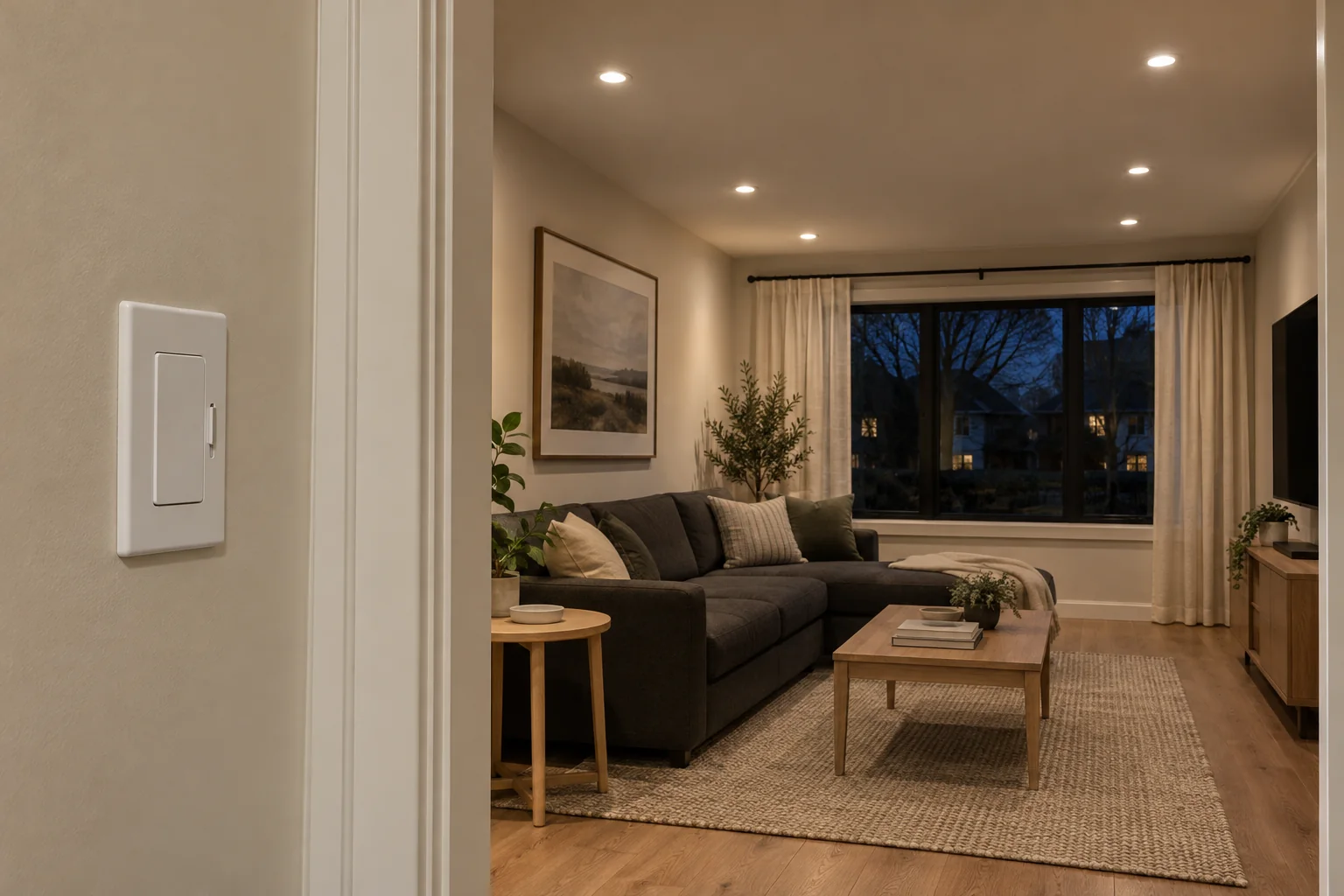
A safe wide photograph can show the room and controlled fixtures, while a second photograph of the intact wall control can show the interface. A still image cannot show the full dimming curve or prove compatibility. A written sentence about what happens is usually more useful than a photograph that only shows lights on.
Know when the symptom needs prompt attention
Persistent dropout, unreliable starting, sudden changes or inconsistent responses deserve assessment when they disrupt use. Do not accept an unexplained new problem as inevitable because the lights are LEDs. Also describe associated sounds, odours or visible damage. Their absence does not establish that an installation is sound, and their presence should not be reduced to a compatibility assumption.
Stop using affected equipment if there is burning odour, smoke, sparking, damage or other signs of an immediate hazard. Seek urgent qualified help; contact emergency services for a fire or immediate danger. Do not continue operating the control to document the symptom, touch damaged equipment or open the plate. Routine inquiry forms are not an emergency response channel.
If a protective device has already operated, include that fact in the account without resetting it or attempting further tests. Do not switch other appliances on and off to investigate a relationship. The useful observation is what occurred; finding an electrical cause belongs to the assessment.
Choose a repair route or a control-planning route
Lighting Repairs is the relevant route when existing operation is unreliable and the cause is unknown. The assessment can separate a product limitation from a fault and establish an appropriate correction. The resulting scope might involve a setting permitted by the instructions, a suitable product replacement or further installation work; none should be promised before review.
If the main goal is a different user experience, such as scenes, convenient control locations or a useful evening range throughout a room, Smart Lighting & Dimmers covers that planning discussion. Tell the assessor both the current symptom and the desired result. “Reliable low lighting for television” sets a clearer goal than requesting whichever dimmer has the most features.
Ask how the proposed combination’s usable range will be reviewed, what product information supports the choice and which associated fixtures or controls are included. A smooth response at one setting does not establish performance throughout every intended mode. The scope should address ordinary everyday operation at the control points the household actually uses.
Prepare a focused Burlington inquiry
Provide the room, the affected group, the visible behaviour, when it started and known recent changes. Include product documents already available and safe photographs of closed equipment. Mention ceiling height, access restrictions and whether the work requires owner or property-management permission. Do not assume a wall control is the only item involved because it is the item you touch.
The Lighting Problems library helps distinguish other existing symptoms. When control range is the central issue, keep the inquiry centred on that range. Use the lighting assessment inquiry to share what you know, what remains unknown and the everyday level of control you want to achieve.
Frequently asked questions
Why do LEDs turn off before the slider reaches the bottom?
A possible explanation is that the LED reaches its supported low-end limit before the control finishes its range. Other product or installation issues may also need review. Describe the behaviour for lighting assessment rather than assuming a setting will fix it.
Does dead travel mean the dimmer is faulty?
Not necessarily. The apparent response depends on the installed combination and its usable range. Product information and assessment are needed before deciding whether the control should be replaced.
Should I buy an LED dimmer to solve the problem?
Choose using the exact fixture or lamp and control information. The compatibility guide explains the selection questions; an unresolved existing symptom may need assessment first.
What information can I provide safely?
Share normal-use observations, room photographs, the intact control and model details from records already available. Do not open controls, fixtures or driver enclosures to obtain information.
Can a smart control improve the dimming range?
Extra features do not establish compatibility or low-end performance. Smart Lighting & Dimmers can help define the desired everyday operation after the current symptom is understood.